Every year, “learn to code” gets easier, free courses, AI coding assistants, endless tutorials. Yet the gap between people who can write some code and people who can build software professionally keeps growing.
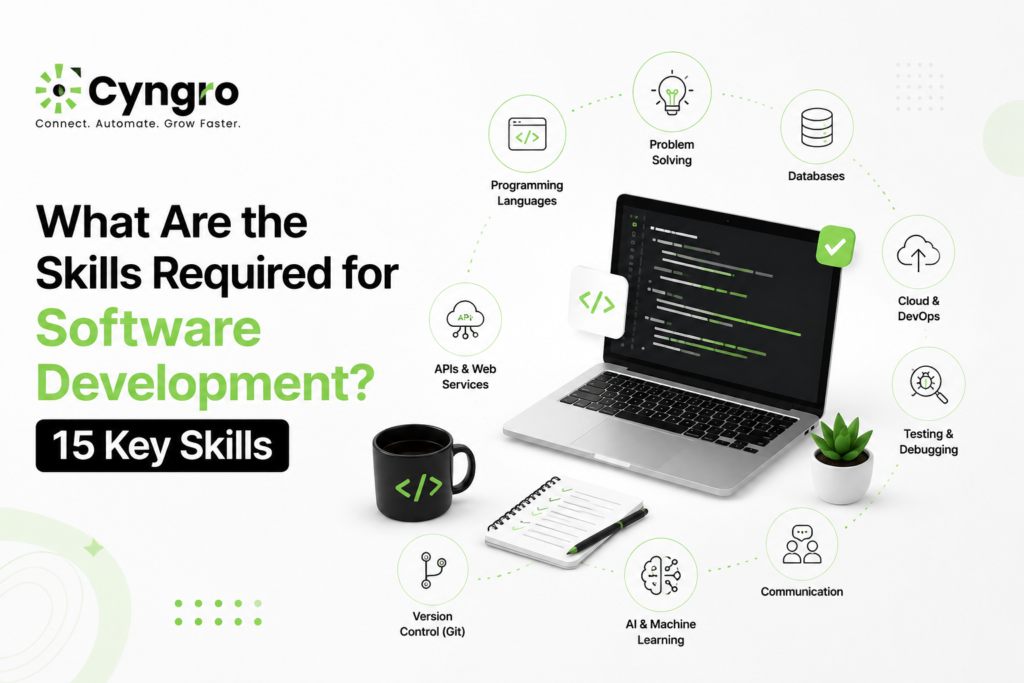
That gap comes down to one thing: the full range of skills required for software development goes far beyond knowing a programming language. Employers, clients, and hiring managers consistently say the same thing, technical skill alone isn’t enough. The developers who succeed combine strong technical foundations with problem-solving ability, communication, and the discipline to keep learning as tools change.
This guide breaks down exactly what those skills are both technical and non-technical how they differ by career stage and specialization, and how to actually build them, whether you’re starting your first developer role or hiring a team to build your next product.
Core Skills Every Software Developer Needs
Software development skills fall into two broad categories, and both matter equally:
- Hard (technical) skills – Programming languages, tools, frameworks, and technical concepts that let you actually build software.
- Soft skills – Communication, collaboration, and problem-solving abilities that determine whether that technical work actually serves the business and the team around it.
A developer with excellent technical skills but poor communication often struggles to work in a team, misses requirements, or builds the wrong thing efficiently. A developer with strong soft skills but weak technical fundamentals can’t execute at all. The strongest developers, and the strongest development teams, combine both.
Let’s break down each category in detail.
Core Technical Skills for Software Development
1. Programming and Scripting Languages
This is the foundation. Most developers specialize in one or two core languages while maintaining working knowledge of others. Commonly required languages include:
- JavaScript/TypeScript – Essential for web development, both front-end and back-end (via Node.js)
- Python – Widely used across web development, data science, automation, and AI/ML
- Java – Common in enterprise systems, Android development, and large-scale backend applications
- C# – Frequently used in enterprise software and game development
- Go and Rust – Growing in popularity for performance-critical and cloud-native systems
The specific language matters less than the ability to think in terms of logic, structure, and problem decomposition, languages can be learned relatively quickly once these fundamentals are solid.
2. Data Structures and Algorithms
Understanding arrays, linked lists, trees, hash maps, and sorting/searching algorithms isn’t academic trivia, it directly affects how efficiently software runs, especially at scale. This knowledge helps developers choose the right approach when performance and memory usage matter.
3. Version Control (Git and GitHub)
Virtually no professional software team works without version control. Git lets multiple developers work on the same codebase without overwriting each other’s work, track every change made, and roll back mistakes safely. Knowing how to branch, merge, and resolve conflicts is considered baseline knowledge for any development role today.
4. Databases and SQL
Almost every application needs to store and retrieve data. Developers need working knowledge of:
- Relational databases (SQL databases like PostgreSQL and MySQL) for structured data
- NoSQL databases (like MongoDB) for flexible, unstructured data
- Writing efficient queries and understanding basic database design principles
5. APIs and Web Services
Modern software rarely works in isolation, it connects to other systems through APIs. Understanding REST APIs (and increasingly GraphQL) is essential for building applications that integrate with payment gateways, third-party services, and other internal systems.
6. Cloud Computing and DevOps
Most software today is deployed and run in the cloud rather than on physical servers. Developers benefit from understanding:
- Core cloud platforms (AWS, Azure, or Google Cloud)
- Containerization tools like Docker
- CI/CD pipelines that automate testing and deployment
- Infrastructure as code, which manages server setups through version-controlled configuration files
7. Testing and Debugging
Writing code is only half the job, making sure it works correctly is the other half. Skills here include writing unit tests, using debugging tools effectively, and understanding different types of testing (unit, integration, and end-to-end).
8. Secure Coding Practices
With cyber threats growing more sophisticated, understanding common vulnerabilities and how to prevent them (like input validation and proper authentication handling) has become a core expectation rather than a specialized skill.
9. AI and Machine Learning Integration
By 2026, AI integration has moved from a niche specialty to a mainstream expectation. Developers increasingly need working knowledge of consuming AI model APIs, understanding prompt design, and evaluating AI-generated output for accuracy, even if they’re not building ML models themselves.
Essential Soft Skills for Software Developers
Technical skill gets code written. Soft skills determine whether that code actually solves the right problem, gets delivered on time, and works well within a team. Here’s what consistently matters most:
Communication
Explaining a technical decision to a non-technical stakeholder, writing clear documentation, and asking the right clarifying questions before starting work all fall under this skill, and it’s consistently rated as one of the most in-demand traits by hiring managers.
Problem-Solving and Critical Thinking
Software development is fundamentally about breaking complex problems into manageable pieces and finding practical solutions, often with incomplete information and shifting requirements.
Collaboration and Teamwork
Most software today is built by teams, not individuals. This means working well within code review processes, respecting shared coding standards, and contributing constructively during team discussions.
Adaptability and Continuous Learning
Technology changes fast. Frameworks that were standard five years ago get replaced. The developers who stay relevant treat learning as an ongoing part of the job, not a one-time effort during school or bootcamp.
Time Management
Balancing multiple tasks, meeting sprint deadlines, and estimating how long work will realistically take are skills that directly affect a team’s reliability and a project’s success.
Emotional Intelligence and Conflict Resolution
Disagreements over technical approaches are common. Developers who can navigate these disagreements constructively without ego or defensiveness, tend to build stronger, more trusted working relationships over time.
Skills by Career Stage: Junior vs. Mid-Level vs. Senior
Expectations shift significantly as developers grow in experience. Here’s a general breakdown:
| Skill Area | Junior | Mid-Level | Senior |
| Coding | Writes functional code with guidance | Writes clean, efficient code independently | Sets coding standards, reviews others’ work |
| Problem-solving | Solves well-defined tasks | Solves ambiguous, multi-step problems | Makes architectural trade-off decisions |
| Communication | Asks clarifying questions | Explains decisions to teammates | Aligns technical work with strategy |
| System design | Limited exposure | Designs individual features/modules | Designs entire systems/architecture |
| Mentorship | Receives guidance | Occasionally supports juniors | Actively mentors team members |
Understanding this progression helps both developers plan their growth and businesses set realistic expectations when hiring at each level.
Skills by Type of Software Development
Different specializations within software development emphasize different skill combinations:
Front-End Development
Focuses on HTML, CSS, JavaScript/TypeScript, and frameworks like React or Vue. Strong front-end developers also need a solid grasp of UI/UX principles and performance optimization for the browser.
Back-End Development
Centers on server-side languages (Node.js, Python, Java, etc.), databases, APIs, and system architecture. Back-end developers need strong data-handling and security knowledge.
Full-Stack Development
Combines both front-end and back-end skills, requiring broader (if sometimes shallower) knowledge across the entire application stack.
Mobile App Development
Requires knowledge of native platforms (Swift for iOS, Kotlin for Android) or cross-platform frameworks (React Native, Flutter), along with an understanding of mobile-specific performance and UX considerations.
Cloud and DevOps Engineering
Focuses heavily on infrastructure, automation, containerization, and deployment pipelines rather than application-level feature development.
Data Engineering and AI/ML Development
Requires strong Python skills, statistics knowledge, and familiarity with machine learning frameworks and large-scale data pipelines.
Businesses building a product often need a mix of these specializations working together, which is exactly why assembling the right team (rather than a single generalist) matters for anything beyond a very simple project. This is one reason many companies turn to a software development consultancy that already has these specializations covered under one roof.
How to Build These Skills: A Practical Roadmap
If you’re starting out or reskilling, here’s a realistic path to build a strong foundation:
Step 1: Learn the Fundamentals
Start with one language, learn core programming concepts (loops, functions, data structures), and build small projects to reinforce what you learn rather than jumping between tutorials without applying anything.
Step 2: Build Real Projects
Tutorials only get you so far. Building actual projects, even small ones, forces you to solve problems that tutorials don’t cover, which is where real skill develops.
Step 3: Learn Version Control Early
Get comfortable with Git from the very beginning. It’s used in virtually every professional development environment, and learning it alongside your first projects builds good habits early.
Step 4: Study Data Structures and Algorithms
Even if you’re not targeting big tech interviews, understanding these concepts improves the quality and efficiency of the code you write day to day.
Step 5: Contribute to Open Source or Collaborative Projects
Working with other people’s code, reading it, following contribution guidelines, responding to feedback, builds both technical and soft skills simultaneously.
Step 6: Learn to Read and Debug Other People’s Code
In real jobs, you’ll spend as much time reading and fixing existing code as writing new code. Practicing this deliberately (not just building from scratch) closes a major gap many self-taught developers have.
Step 7: Practice Explaining Your Work
Write documentation, explain your projects to non-technical friends, or record yourself walking through your code. This directly builds the communication skill that technical training usually skips.
Step 8: Keep Building — Don’t Stop After One Project
Skill compounds with repetition. Developers who build multiple small-to-medium projects over time consistently outpace those who spend the same hours perfecting a single project.
Certifications and Learning Resources Worth Considering
While hands-on project experience matters most, certain certifications and resources can validate specific skills and fill knowledge gaps:
- Cloud certifications (AWS Certified Developer, Azure Fundamentals) validate cloud skills for infrastructure-focused roles
- Coding bootcamps compress fundamentals into an intensive, structured timeframe
- Open courseware and structured online courses for specific languages or frameworks
- Developer communities and forums for real-world troubleshooting and peer learning
Certifications alone rarely replace real project experience, but they help fill specific gaps and can signal credibility to employers or clients when experience is still limited.
Why These Skills Matter for Businesses Hiring Developers
If you’re a business owner rather than a developer, understanding this skill landscape still matters, because it directly affects the quality of software you get built.
When evaluating a development team or partner, look for:
- A mix of technical specializations, not just one generalist covering everything
- Evidence of strong communication practices, regular updates, clear documentation, structured processes
- A track record of solving real business problems, not just technically impressive but irrelevant work
- Awareness of security and testing practices, not just feature delivery speed
- A team structured by experience level, with senior oversight on architecture decisions
Businesses that skip this evaluation often end up with software that “works” technically but doesn’t actually solve their real business problem or that becomes unmaintainable within a year. This is exactly the gap a well-structured custom software development company is built to close, by matching the right technical and communication skill sets to your specific project.
Common Skill Gaps Companies Face When Hiring Developers
Even experienced hiring teams run into predictable gaps. Watch for these when evaluating candidates or partners:
- Strong coding, weak communication – Technically capable developers who struggle to explain decisions or collaborate cross-functionally
- Framework-deep, fundamentals-shallow – Developers who know one framework well but struggle when requirements shift outside that framework’s assumptions
- No testing discipline – Code that works in demos but breaks under real-world edge cases due to insufficient testing
- Security blind spots – Functional features built without considering basic security implications
- Limited system-level thinking – Developers who can build individual features but struggle to reason about how those features affect the broader system
Identifying these gaps early, during hiring or when evaluating an outsourced team — prevents costly rework later in a project.
Frequently Asked Questions
What are the most important skills required for software development?
The most important skills combine technical fundamentals (programming languages, data structures, version control, databases) with soft skills like communication, problem-solving, and adaptability.
Do I need a computer science degree to become a software developer?
No. While a degree can provide structured fundamentals, many successful developers are self-taught or bootcamp-trained, provided they build strong practical project experience and fundamentals.
What is the most important skill for a beginner software developer to learn first?
Start with core programming fundamentals in one language, then learn version control (Git) early, since it’s used across virtually every professional development environment.
How long does it take to learn the skills required for software development?
Basic proficiency in one language and fundamental concepts can take 6–12 months of consistent practice; developing job-ready skills across the full stack typically takes 1–2 years of active building and learning.
Are soft skills really as important as technical skills in software development?
Yes. Hiring managers consistently rank communication and problem-solving among the top factors separating successful developers from technically skilled but ineffective ones.
Final Thoughts
The skills required for software development have evolved well beyond simply “knowing how to code.” Today’s developers need a working command of core technical fundamentals, an understanding of modern tools like cloud platforms and AI integrations, and the soft skills to communicate clearly and solve problems collaboratively.
For businesses, understanding this skill landscape isn’t just useful trivia — it’s the difference between hiring a team that ships reliable, maintainable software and one that leaves you with technical debt and missed deadlines.
Looking to work with a team that brings the right mix of technical depth and communication? Cyngro’s development team combines specialized technical expertise across the full stack with a communication-first process, so your project gets built right the first time. For a broader look at how the development process works end-to-end, see our guide on what software development actually involves.