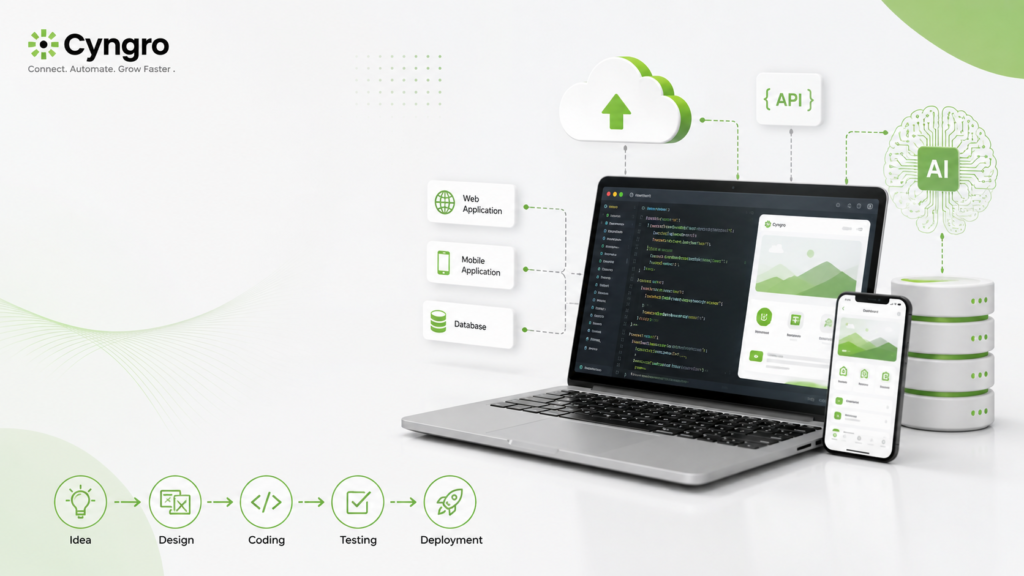
Every app you tap, every dashboard you check, every online payment you make, all of it exists because of software development. Yet when business owners ask “what is software development?”, most answers online are either too technical or too vague to actually help them make a decision.
This guide breaks it down in plain language. You’ll learn what software development actually means, how the process works from idea to launch, which development models companies use, what it costs, and most importantly, how to choose a software development company that turns your idea into a product customers actually want to use.
Whether you’re a startup founder validating your first MVP or an enterprise leader planning a digital transformation, this is the only guide you’ll need.
What Is Software Development?
Software development is the process of designing, building, testing, deploying, and maintaining software applications. It covers everything from a single mobile app built by a solo developer to a global banking platform maintained by hundreds of engineers.
In simple terms: software is a set of instructions that tells a computer, phone, or device what to do. Software development is the discipline that creates those instructions in a structured, repeatable, and secure way.
The goal isn’t just “writing code.” A successful software development process has to:
- Solve a real problem for real users
- Work reliably at scale
- Stay secure against threats
- Be easy to update as business needs change
Modern teams rarely build software in isolation anymore. Most organizations now follow a DevOps model, where development and IT operations teams work together, using automation to ship updates faster and with fewer errors. This shift is one of the biggest reasons software today feels more polished and reliable than it did a decade ago.
If you’re evaluating whether to build software in-house or bring in outside expertise, it helps to first understand exactly what the process involves, which is what the rest of this guide covers.
Why Software Development Matters for Every Business
It’s not an exaggeration to say software now runs the modern economy. Retailers use it to process orders. Hospitals use it to manage patient records. Manufacturers use it to track supply chains in real time.
Here’s why investing in proper software development has become non-negotiable for growing businesses:
- Competitive advantage – Custom software lets you do things off-the-shelf tools can’t.
- Efficiency – Automating manual processes saves hours of labor every week.
- Scalability – Well-architected software grows with your business instead of holding it back.
- Customer experience – Fast, intuitive digital products directly impact retention and revenue.
- Data-driven decisions – Custom systems can be built to capture exactly the data your business needs.
Businesses that delay software investment often end up patching together spreadsheets, disconnected tools, and manual workarounds, which becomes more expensive to fix later than building it right the first time. This is why many companies now work with a customized software development company rather than trying to force generic tools to fit unique workflows.
What Is IT Software? Understanding the Basic Types
Before going deeper into the development process, it’s worth clarifying a common point of confusion: what is IT software, and how is it different from other types of software?
IT software generally refers to the software systems that support an organization’s internal technology infrastructure, think network management tools, cybersecurity systems, database management platforms, and IT service management software. It’s the technology that keeps a business’s digital operations running behind the scenes.
Broadly, software falls into four categories:
1. System Software
Runs the core operations of a device, operating systems, drivers, and utilities that manage hardware. Without system software, nothing else can run.
2. Application Software
The programs people use directly to complete tasks: a CRM, an accounting tool, a mobile banking app, or an e-commerce storefront. Most business software development projects fall into this category.
3. IT Software (Enterprise & Infrastructure Software)
Covers network monitoring, cybersecurity platforms, cloud management consoles, and IT service desks. This is what most people mean when they ask “what is IT software development” building and maintaining the systems that keep an organization’s technology infrastructure secure and operational.
4. Embedded Software
Software built into physical devices that aren’t traditionally considered “computers” cars, medical devices, industrial machines, and IoT sensors.
Understanding which category your project falls into helps determine the right team, tech stack, and timeline for your build.
IT Software Development vs. General Software Development
IT software development specifically focuses on building tools that support an organization’s internal technology operations, things like network security systems, IT asset management platforms, helpdesk software, and infrastructure monitoring dashboards.
General software development, on the other hand, is a broader term that includes customer-facing applications, SaaS products, mobile apps, and websites.
The distinction matters because:
- IT software projects usually prioritize security, compliance, and system stability above all else.
- Customer-facing software projects usually prioritize user experience, performance, and conversion.
- The two often require different specialists, even within the same company.
A strong development partner should be able to handle both, or clearly tell you which one they specialize in. Companies offering custom software development services typically structure their teams around this distinction to make sure the right engineers are assigned to the right kind of build.
Who Builds Software? Developers, Engineers & Programmers
People often use “developer,” “engineer,” and “programmer” interchangeably, but there are subtle differences:
Programmers (Coders)
Write the actual source code based on specifications from developers or engineers. They focus on implementation — writing, testing, and debugging code in languages like Python, Java, or JavaScript.
Software Developers
Design, build, and test software with a project-based focus. A developer might own a specific feature or fix within a larger product, working closely with designers and product managers.
Software Engineers
Take a systems-level view. They’re responsible for how different components interact, how the software scales, and how it holds up under real-world conditions, often overseeing architecture decisions and long-term maintainability.
In practice, most modern teams blend these roles, especially in agile environments where developers wear multiple hats throughout a project’s lifecycle.
The Software Development Life Cycle (SDLC): Step by Step
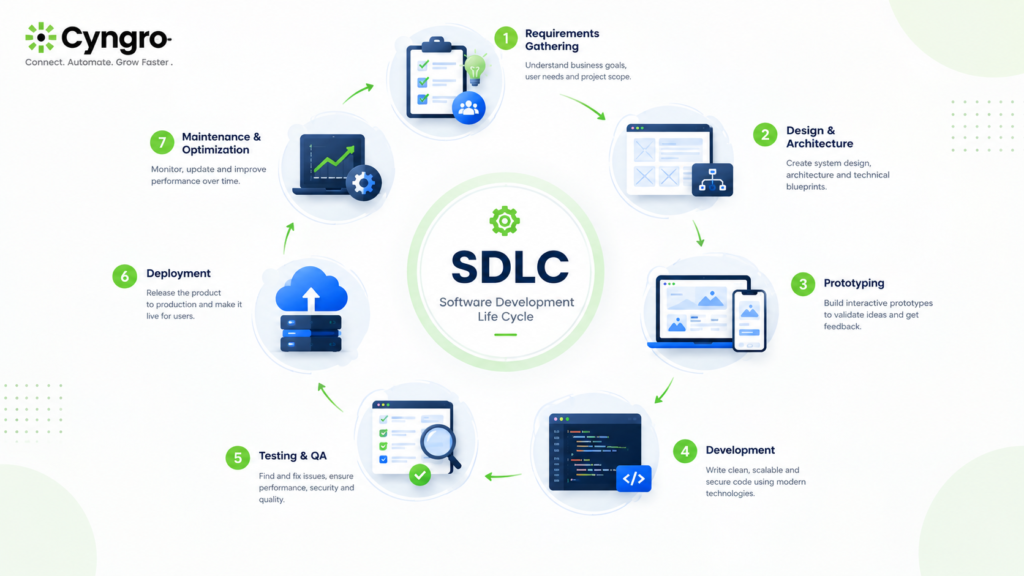
The Software Development Life Cycle (SDLC) is the structured framework teams use to plan, build, and maintain software. Understanding these steps helps you know exactly what you’re paying for when you hire a development team, and what questions to ask at each stage.
Step 1: Requirements Gathering & Analysis
Before a single line of code is written, teams need to understand the problem. This involves stakeholder interviews, market research, and defining what “success” looks like for the project. Skipping this step is the #1 reason software projects fail or run over budget.
Step 2: Design & Architecture
Here, teams map out the technical blueprint: database structure, API integrations, system architecture, and UI/UX wireframes. Good architecture decisions made now save massive rework costs later.
Step 3: Prototyping / Building a Model
Teams often build a rough version of the product to test assumptions early, catch obvious flaws, and get stakeholder feedback before committing to full development.
Step 4: Development (Writing the Code)
This is the stage most people picture when they think of “software development” — engineers write the actual code that brings the design to life, often using AI-assisted tools to speed up repetitive tasks.
Step 5: Testing & Quality Assurance
QA teams run automated and manual tests to catch bugs, security vulnerabilities, and performance issues before the product reaches users. Skipping thorough QA is one of the most common — and costly — mistakes in software projects.
Step 6: Deployment
The software is released to users. This might mean a full public launch or a smaller beta release to a limited group first, so the team can catch issues before scaling up.
Step 7: Maintenance & Optimization
Software isn’t “done” at launch. Ongoing monitoring, bug fixes, security patches, and performance tuning keep it running smoothly as user needs and technology evolve.
Quick tip: When evaluating a development partner, ask which of these seven steps they include in their standard process, and which ones cost extra. This alone reveals a lot about how the company operates.
Popular Software Development Models
A development model is the methodology a team follows to move through the SDLC. The right model depends on your project’s complexity, timeline, and how much flexibility you need along the way.
- Waterfall – A linear, step-by-step process. Best for small, well-defined projects where requirements won’t change.
- Agile – Breaks the project into short “sprints,” allowing continuous feedback and adjustments. The most common model for modern software projects.
- DevOps – An extension of Agile that merges development and operations teams, using automation for faster, more reliable releases.
- Iterative – Repeated cycles of development, refining the product with each pass.
- Spiral – Combines Waterfall’s structure with iterative risk analysis, often used for large, complex enterprise projects.
- Rapid Application Development (RAD) – Prioritizes speed and real-world feedback over heavy upfront planning.
- Lean – Focuses on cutting waste and inefficiency at every stage of development.
Most established teams today default to Agile or DevOps because they reduce risk, problems get caught in small sprints rather than at the very end of a long build. If you’re comparing vendors, ask directly which model they use and why it fits your specific project; a good software development consultancy should be able to explain this clearly, not just repeat buzzwords.
Types of Software Development
Not all software development looks the same. Depending on what you’re building, the tech stack, team structure, and timeline will vary significantly.
Custom Software Development
Software built specifically for one organization’s unique workflows and requirements, as opposed to generic, one size-fits-all commercial tools. This is usually the right choice when your business processes don’t fit neatly into existing software.
Web Development
Building websites and web applications, from simple marketing sites to complex, data-heavy platforms.
Mobile App Development
Building applications for iOS and Android, either as native apps for each platform or cross-platform apps that run on both from a single codebase.
Cloud-Native Development
Building applications specifically designed to run in cloud environments, using microservices and containers so different parts of the application can scale independently.
Front-End Development
Everything the user sees and interacts with layouts, buttons, navigation, and the overall visual experience.
Back-End Development
The server-side logic that powers the application behind the scenes, databases, APIs, authentication, and business logic.
Full-Stack Development
Covers both front-end and back-end work, giving one team (or developer) ownership of the entire application.
Low-Code / No-Code Development
Visual development platforms that let teams build applications with minimal manual coding, useful for simpler internal tools, though often limiting for complex, custom requirements.
Businesses that outsource this work often prefer partners with experience across multiple types, since most real-world projects blend several of these categories rather than fitting neatly into one box. This is a common reason companies choose to outsource custom software development rather than trying to hire and manage every specialist in-house.
AI’s Growing Role in Software Development
Artificial intelligence has changed how software gets built faster than almost any other shift in the industry’s history. Here’s where it’s having the biggest impact:
- Code generation – AI tools can generate functional code snippets from plain-language prompts, speeding up repetitive coding tasks.
- Autocompletion – Smart suggestions help developers write code faster and with fewer errors.
- Automated testing – AI can generate and run test cases far faster than manual QA alone.
- Code translation – AI tools help modernize legacy systems by translating code between languages.
- Predictive monitoring – AI-powered tools flag potential performance issues before they cause outages.
Importantly, AI hasn’t replaced development teams, it’s made experienced developers significantly faster and more accurate. Companies still need skilled engineers to review AI-generated code, make architectural decisions, and ensure the final product actually solves the business problem it was built for.
How Much Does Software Development Cost?
This is usually the first question business owners ask, and the honest answer is: it depends. But here are the main factors that drive cost up or down:
- Project complexity – A simple internal tool costs far less than a multi-platform enterprise system.
- Team location and structure – In-house teams, freelancers, and outsourced agencies all come with different cost structures.
- Design requirements – Custom UI/UX work adds cost but often pays for itself in user retention.
- Integrations – Connecting to third-party APIs, payment gateways, or legacy systems adds development time.
- Ongoing maintenance – Budget for updates, security patches, and support after launch, not just the initial build.
As a rough guide:
| Project Type | Typical Range |
| Simple MVP / small app | $15,000 – $50,000 |
| Mid-size custom platform | $50,000 – $150,000 |
| Enterprise-grade system | $150,000+ |
These numbers vary widely by region, team seniority, and scope — treat them as a starting point for budgeting conversations, not a fixed quote.
How to Choose the Right Software Development Company
This is the decision that determines whether your project succeeds or turns into an expensive lesson. Here’s what actually matters when evaluating partners:
1. Relevant Experience
Look for a portfolio with projects similar in scale and industry to yours — not just an impressive-looking website.
2. Clear Communication Process
Ask how often you’ll get updates, who your main point of contact is, and how they handle disagreements or scope changes.
3. Technical Transparency
A trustworthy partner explains their tech stack choices in plain language and can justify why they fit your project — not just because it’s what they already know.
4. Security & Compliance Practices
Especially important for finance, healthcare, or any project handling sensitive user data. Ask directly what security standards they follow.
5. Post-Launch Support
Software needs maintenance. Confirm what happens after launch, is support included, and for how long?
6. Pricing Structure
Fixed-price, time-and-materials, or dedicated team models all have trade-offs. Make sure the pricing model matches your project’s certainty level (well-defined projects suit fixed price; evolving projects suit time-and-materials).
Businesses that get this evaluation right upfront tend to avoid the most common software project failures: scope creep, missed deadlines, and products that don’t actually match user needs. Many growing companies work with a custom software development company in the USA specifically to get this level of accountability and communication from day one.
Common Software Development Challenges (And How to Avoid Them)
Even well-planned projects run into friction. Here are the most common issues — and practical ways to prevent them:
- Unclear requirements → Invest real time in the discovery phase before development starts.
- Scope creep → Lock in a defined MVP scope first; treat “nice-to-have” features as a phase two.
- Poor communication → Set a fixed cadence for updates (weekly demos work well) rather than relying on ad-hoc check-ins.
- Underestimating QA → Build testing time into the schedule from the start, not as an afterthought.
- Ignoring post-launch maintenance → Budget for ongoing support before launch, not after something breaks.
- Choosing the cheapest option → The lowest quote often means cut corners on testing, security, or documentation, all of which cost more to fix later.
The businesses that navigate software development most successfully treat it as an ongoing partnership, not a one-time transaction.
Frequently Asked Questions
What is software development in simple terms?
Software development is the process of designing, building, testing, and maintaining computer programs and applications that help people or businesses complete tasks.
What is the difference between software development and IT software development?
Software development is a broad term covering all types of applications. IT software development specifically refers to building tools that manage and support an organization’s technology infrastructure, such as network monitoring or cybersecurity systems.
What are the main steps in software development?
The core steps are requirements analysis, design, development, testing, deployment, and maintenance — collectively known as the Software Development Life Cycle (SDLC).
How long does software development take?
Timelines vary widely: a simple MVP might take 8–12 weeks, while an enterprise-grade platform can take 6 months to over a year, depending on complexity and scope.
Should I build software in-house or outsource it?
It depends on your budget, timeline, and internal technical expertise. Outsourcing to a specialized team often gets projects to market faster and reduces the risk of costly missteps, especially for businesses without an existing engineering team.
Final Thoughts
Software development is no longer just a technical function tucked away in an IT department, it’s a core driver of business growth, customer experience, and long-term competitiveness. Understanding the process, from requirements gathering through post-launch maintenance, puts you in a far stronger position to make smart decisions about your next project.
Whether you’re building your first MVP or modernizing a legacy enterprise system, the right development partner should feel like an extension of your team, one that understands your business goals as clearly as they understand the code.
Looking to build software that actually moves your business forward? Cyngro’s custom software development team can help you turn your idea into a secure, scalable product, from initial strategy through post-launch support.